
Bloomington, Minnesota sits on Mni Sota Makoce, the ancestral lands of the Dakota people. Minnesota’s rich indigenous culture has been on full display recently, with Minneapolis restaurant Owamni winning Best New Restaurant at the 2022 James Beard Awards. Owamni is the brainchild of Sean Sherman, aka “The Sioux Chef,” who uses only ingredients native to Minnesota in his inventive, delicious cooking. If you’re seeking to learn more about Minnesota’s native roots, follow this itinerary to visit sites that are significant to the Dakota tribe and our indigenous history.
Historic Fort Snelling
Located adjacent to Bloomington and the Minneapolis-St. Paul International Airport, Historic Fort Snelling resides in an area called Bdote by the Dakota people. Bdote translates to “a place where two rivers come together” and refers to the confluence of the Minnesota and Mississippi Rivers. The area where Fort Snelling now stands is considered sacred to the Dakota, and they can track their history at Bdote as far back as 10,000 years. Once Europeans arrived in Minnesota and built the military post now known as Fort Snelling, they began to gradually expel the Dakota people from the area, culminating in the US-Dakota War of 1862.
Mystic Lake Casino
Mall of America visitors can catch a free shuttle to Mystic Lake Casino in Prior Lake every hour on the hour. Mystic Lake is owned and operated by the Shakopee Mdewakanton Sioux Community (SMSC), and profits from the casino and hotel property directly benefit the SMSC. The sprawling complex includes a 150,000-square-foot casino plus 18-hole golf course and performance space that hosts entertainers such as Penn and Teller, Ludacris, and Wheel of Fortune Live.
Minnehaha Falls
Old Town Hall Museum
The Bloomington Old Town Hall Museum is housed in the historic Old Town Hall, which was built in 1892 and extensively renovated two times in the past century. The building served as town headquarters and a meeting place for the Town Board. The City of Bloomington’s administrative offices were housed in the Old Town Hall until 1964. The museum collection includes objects, books, clippings and memorabilia linked to the Bloomington area. Two featured collections are the Irwin D. Norling Collection and Bloomington Dugout Canoe.
Indigenous Arboretum and Botanical Gardens at Pond Dakota Mission Park
This Indigenous Plant Arboretum was developed in a 30-foot diameter circle near the middle of the park. The garden features a wide variety of important Indigenous plants and shrubs, many of which no longer grow in the area. It serves as a learning tool for visitors to Pond Dakota Mission Park.
Minnehaha Falls
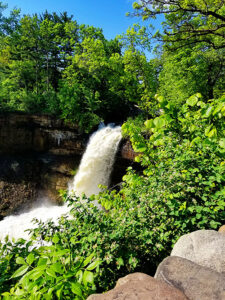
Just north of Bloomington and easily accessed via the Metro Transit blue line light rail is Minnehaha Falls, one of the Twin Cities’ most popular destinations for visitors and another notable spot for Native American history in Minnesota. The word Minnehaha means waterfall in Dakota, and the location was made famous by Henry Wadsworth Longfellow’s poem “The Song of Hiawatha”. Longfellow’s fictional tragic love story tells the tale of Hiawatha, an Ojibwe man, and Minnehaha, a Dakota woman, and a statue of Hiawatha and Minnehaha stands near the Falls today.
Minneapolis Institute of Art
Minneapolis Institute of Art, or MIA, boasts a robust collection of Native American art and regularly hosts educational programs with experts in the field. Highlights from the collection that are currently on display include a sheep’s hide dress made in the mid-1800s by a Nez Perce seamstress, a bird sculpture carved from stone more than 2,000 years ago, and a pair of Christian Louboutin pumps given a Native American aesthetic by artist Jamie Okuma.
Hoċokata Ti cultural center
The SMSC’s new cultural center, Hoċokata Ti, is a must-see for any visitor interested in learning more about Minnesota’s indigenous roots. The portion of the center that is open to the public, Mdewakanton: Dwellers of the Spirit Lake, explores the history and culture of the Dakota people. The adjacent gift shop features a variety of Native-made items that build upon the experience visitors have in the cultural center.
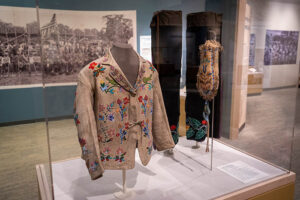
Our Home exhibit (photo credit: Minnesota History Center)
Minnesota History Center
Now on display at the Minnesota History Center is Our Home, an exhibit about the original Minnesotans from the Dakota and Ojibwe tribal nations. Visitors to the exhibit are invited to learn more about Native communities’ stories of survival, resiliency, and adaption through a collection of historical objects sourced from the museum’s vast archives. Members of the Dakota and Ojibwe tribes were directly involved in collecting materials for Our Home.
Powwows
Minnesota’s tribal nations regularly hold powwows, or “wacipi” in the Dakota language, that attract visitors from across the country who want to experience a traditional Native American celebration. SMSC members perform a powwow at Mall of America’s Huntington Bank Rotunda each year, and outdoor powwows are held throughout the summer in communities across the state. Visit Explore Minnesota’s website to learn more about what you can expect to see at a powwow, as well as etiquette tips.
For more information about Minnesota’s indigenous culture in the past and present, visit the Shakopee Mdewakanton Sioux Community’s website.